NZ U20s 2026
-
With the end of the Super Rugby U20 tournament there has been a couple of recent articles about the new player ID system they will be using before eventually selecting the NZ U20 squad.
- 180 players nationwide have been taking part in testing.
- The players will be retested in February.
- 100 players will be selected for a camp in March.
- They will play internal games.
As some of these players will have a NDC with their SR club, those more high-profile players will likely get to play in pre-season or Development games.
-
2026 should be an interesting year for the NZ U20s. It’s the age grade graduation of the 2024 U18 cohort, who lost rather convincingly to a touring Australian U18 side. With the top rep team, NZ Schools, losing not only to the Australians but to a Māori selection as well, expectations might not be too high for this particular age group when it comes to the upcoming U20 competitions.
Then again, painful losses do create opportunities. I was watching some footage of Canterbury U19s recently and a player stood out to me who I hadn’t seen before. Frankie Meates, the Canterbury openside flanker, wasn’t selected for any of the representative teams in 2024. Instead, lining up in the 7-shirt were Aio Keith (NZ Schools), Micah Fale (NZ Barbarians U18) and Jayden Broome (Māori U18), all of whom will also come into consideration for next year’s U20 team, with Fale and Keith already earning selection honours in 2025.
Had these rep teams been incredibly successful, it might’ve been challenging for Meates to force his way in. With the pathway rather struggling at U18 level as it is, however, we are looking at a much more open and level playing field.
Meates made sure to take his opportunity during the U19 games, as he was close to irresistible for a dominant Canterbury side. The former Christ's College openside bears a strong resemblance to the typical Cantab flanker: he is effective when playing close to the ruck, both on attack and in defence, he runs immaculate support lines and he consistently flirts with the borders of legality. At the defensive ruck, he shows an excellent feel for the timing and mechanics of the breakdown, allowing him to earn holding penalties, pilfer the ball or just make a mess of opposition ball.
https://media2.giphy.com/media/v1.Y2lkPTc5MGI3NjExOWZzcXU5cHhwd3NwdjM0b292ZDZpYXRvNGN2OXFheDJydXg1bXJsMyZlcD12MV9pbnRlcm5hbF9naWZfYnlfaWQmY3Q9Zw/B8IMWaY4rRTSMaZvRf/giphy.gif
https://media0.giphy.com/media/v1.Y2lkPTc5MGI3NjExa3A4ZnVyN3BhN204eGg2d2lhbnF6MHlwaWQ1YWhtMjljNzgwOTZueCZlcD12MV9pbnRlcm5hbF9naWZfYnlfaWQmY3Q9Zw/gxFOWTgxBUr8gmtqN6/giphy.gif
https://media1.giphy.com/media/v1.Y2lkPTc5MGI3NjExOWE0aDNybWdsc2xodnhmZ2w3YmxveTl4NnZ5M2ZhcjFpNWF1a2dkaCZlcD12MV9pbnRlcm5hbF9naWZfYnlfaWQmY3Q9Zw/KSD8DM00gkIbbECBmp/giphy.gif
https://media4.giphy.com/media/v1.Y2lkPTc5MGI3NjExcWF4dXY1em41MjhtZDBkaHhxM3R3NWp0YTY0bmowandlcnJxcnZydSZlcD12MV9pbnRlcm5hbF9naWZfYnlfaWQmY3Q9Zw/psudfz6vY8xpcvUjjy/giphy.gif
Meates being a menace at the breakdownWhat makes Meates somewhat more unique is that he complements this classical flanker skillset with a very complete attacking game, showing a turn of pace, step and fend that any back would be proud of.
https://media4.giphy.com/media/v1.Y2lkPTc5MGI3NjExM2Z6c2NpMWtsNjhqczU3YTA2ZDUwZWVjdG9uMmdyeG5ycTRiamQzYiZlcD12MV9pbnRlcm5hbF9naWZfYnlfaWQmY3Q9Zw/uQwLaX0tTLNB9QWbna/giphy.gif
https://media4.giphy.com/media/v1.Y2lkPTc5MGI3NjExZzFibTI0NWV1bGc4eHQ0NmYzMTZuM2JidGVrMDlqOTZwYnB3NzNieCZlcD12MV9pbnRlcm5hbF9naWZfYnlfaWQmY3Q9Zw/m0542dBMGzNzYE4rya/giphy.gif
https://media2.giphy.com/media/v1.Y2lkPTc5MGI3NjExaXphNGd3MzFwN2V3OHQ3bXE2OTl6bWFlNzZwdnRoYmljZGZicTRhcSZlcD12MV9pbnRlcm5hbF9naWZfYnlfaWQmY3Q9Zw/oO6QHQavPyUp9b4MgJ/giphy.gif
https://media2.giphy.com/media/v1.Y2lkPTc5MGI3NjExZ2E1NjZ5cDl2b3JpdThzaTV3Ym5jM2xiY3hxd2o2dXBlanBncG04ayZlcD12MV9pbnRlcm5hbF9naWZfYnlfaWQmY3Q9Zw/Qa8uTJv8PJ2Fmmsk41/giphy.gif
Meates showing the skills of a backMeates isn't too dissimilar to the newest openside recruit in Christchurch, Oli Mathis, in that he could easily act as a forward/back-hybrid. He shows great ability to be effective on the edge, displaying a good understanding of space as well as the athleticism and distribution skills to make that space count.
So how will the NZ U20s fare in 2026? Perhaps the poor results at U18 level from 2024 onwards have tempered expectations somewhat, with the NZ rep sides seemingly falling behind their Australian counterparts. And yet, this has potentially opened the door for players who weren’t yet firmly embedded within the national pathways, to stake their claim and to help right the ship. And, as Frankie Meates has shown for the Canterbury U19s, there are still plenty of talented players running around, hungry for their shot at glory in the black jersey.
-
@Mauss Three of the NZ U20 loose forwards from this year are also eligible for 2026 - McLeod, Woodley and Fale. The latter seems to be used more as a no.8 now, so that could be your likely starting loose forward trio. Aio Keith was playing no.8 for the Auckland U19s.
As you say, hopefully others will be identified that weren't involved in the U18 teams.
-
@Mauss It's interesting that next years team doesn't look as bad as you would have thought with the lack of success at the schoolboy level. Particularly with the success of Sinton & Muliaina at Provincial level last year. It's scary to think Muliaina is eligible for the next 2 Under 20 world cups
-
I don't think that the backs have been the problem in recent years, certainly not the attack. Defence maybe.
The issue has been the lack of size/power in the tight five. So the selection of the props and locks will determine how successful the NZ team is. Frazer Brown must be younger than I thought as he and Tevita Tatafu were the Auckland U19 locks. Throw in Johnny Falloon, who debuted for Wellington in the NPC. Props? Anyones guess if the 2024 NZS cohort has developed in club rugby since U18s.
-
Would be massive if Jayden Broome can recover and get back to where he was after falling from a roof and being in hospital for an extended period.
-
@Bovidae said in NZ U20s 2026:
@Mauss Three of the NZ U20 loose forwards from this year are also eligible for 2026 - McLeod, Woodley and Fale. The latter seems to be used more as a no.8 now, so that could be your likely starting loose forward trio. Aio Keith was playing no.8 for the Auckland U19s.
As you say, hopefully others will be identified that weren't involved in the U18 teams.
McLeod’s also been playing at number 8 for Canterbury U19s and Crusaders U20s. I reckon he’s in with a good chance of not only playing there but also of captaining the side. That said, I do rate Fale really highly as well. There are plenty of good options in the loose forwards so they’ll need to find the trio that provides the best balance.
It’s as you say, it will be in the tight five where the strength of the team will be decided. I think lock has reasonable depth. There’s Brown, Tatafu and Falloon, as you mentioned, as well as George Prouting and Jake Frost from Canterbury. Frost lacks height but he provides a lot of grunt and work rate. I’ve read some good things about North Harbour’s Preston Morunga but I haven’t seen him play yet.
As far as props are concerned, tighthead is probably the big question mark for me. Johnston and Ahloo (’25 U20s) are good players but haven’t really been convincing in the set piece. I like the look of Ethan Webber (Otago U19, Māori U18) but he’s not the finished product either. My hope is that players like Kaiva Tulimanu (Westlake Boys, NZ Barbarian U18s) get more of a shot: he doesn’t look particularly athletic but he’s hard to move at scrum time and is a big body in the maul.
But if recent selections are anything to go by, the NZ U20s emphasize mobility and work rate for the props rather than set piece ability. Can’t say I completely agree with that policy.
-
Recently, I watched a bunch of games featuring Mika Muliaina – ranging from his First XV appearances for Southland Boys’ High to some of his recent showings for the Stags in the NPC – as I wanted to familiarize myself a bit with his game and see what kind of first five he actually is.
The thing that stood out to me was Muliaina’s patience. He doesn’t try to create a line break every time he gets the ball – an affliction young 10s can occasionally suffer from (see: Rico Simpson, young Damian McKenzie) – but is more than willing to just keep the ball moving, waiting for an opportunity to eventually present itself. And when these opportunities do present themselves, Muliaina has shown the ability to make the final pass.
https://media2.giphy.com/media/v1.Y2lkPTc5MGI3NjExcGZtNGxsMHV5d2p0bmUyNmhwaTEwZmN6bW1hMnp6MGpzbWNmOWg5aCZlcD12MV9pbnRlcm5hbF9naWZfYnlfaWQmY3Q9Zw/6TRxn3OWxuLU6MLpgp/giphy.gif
https://media1.giphy.com/media/v1.Y2lkPTc5MGI3NjExcXY3NTNienVqNm1oeHdoY25wOGJnMmthdGE0dHVrbGxnZHZseGtrZiZlcD12MV9pbnRlcm5hbF9naWZfYnlfaWQmY3Q9Zw/JpPvTQjMoKJrOUucp4/giphy.gif
Muliaina is patient for both scores, letting the forwards contract the opposition defence through multiple carries up the middle, before pulling the trigger for the easy scoreMuliaina is, in other words, a facilitator: someone who uses his vision and distribution abilities to put others into space more than looking to attack the space himself. The stats, across the different high performance-levels, further back this up.

Some of Muliaina’s per80 numbers: kicking, passing, running, defenders beaten, tackles completed, try assists and line break assists. All stats are my own, apart from those from the NPC, which I took from RugbyPassMuliaina has relatively low run numbers, especially when comparing him to some of his U23 peers like Rico Simpson (9.1 r/80), Harry Godfrey (9.3 r/80) and Lucas Cashmore (7.1 r/80). But what he perhaps lacks as a running threat, he makes up for in distribution, with high passing numbers (26.7 p/80 in the NPC) as well as solid line break assist-production (2.8 LBA/80 in the SR U20 tournament).
While Muliaina can sometimes be a tad too passive in attacking the line, he is at his best when paired with another genuine gamebreaker in the spine (Dylan Pledger for the Highlanders U20s; Jimmy Taylor for Southland Boys; Rios Tasmania for the NZ Barbarians U18s). A combination with someone like Cohen Norrie, the diminutive Auckland fullback, seems likely, with Norrie a lethal attacking threat with time and space at second receiver.
https://media3.giphy.com/media/v1.Y2lkPTc5MGI3NjExcmt6OXU4em1vOGNqNTQ0a3Rianl5dmdsaGJyZjg0dG1jd2s2ZjgwdiZlcD12MV9pbnRlcm5hbF9naWZfYnlfaWQmY3Q9Zw/VJW6CFcpKkTFYyTM6L/giphy.gif
https://media2.giphy.com/media/v1.Y2lkPTc5MGI3NjExNGk2NnhtOGpsNGNoamI3aTMzNHg4MmRnZmRyNHpkdWowdGtwaXp0ZCZlcD12MV9pbnRlcm5hbF9naWZfYnlfaWQmY3Q9Zw/QOPU7YIuonKAIHqICW/giphy.gif
Norrie is great at using his speed to isolate defenders, being able to both cut back inside and connect or burn them on the outside. He could form a potent combo with Muliaina, with the latter putting Norrie into spaceIt is when combined with this kind of X-factor that the value of a player like Muliaina truly comes to the fore, as he excels in one of the core areas of first five-play, territorial kicking.
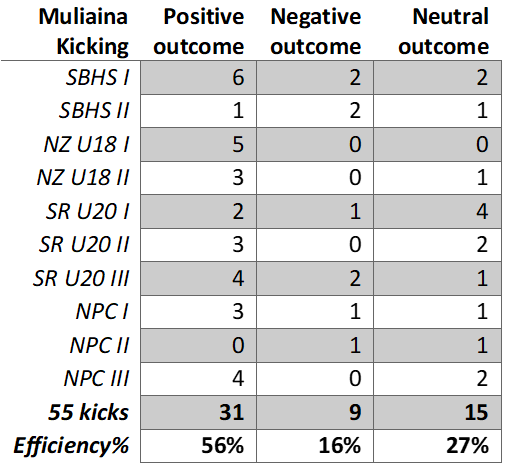
Muliaina’s kicking outcomes across multiple games and levels (First XV, U18 rep rugby, U20 rep rugby and senior rep rugby). What distinguishes outcomes is based on territory: if the kick moves the team closer to the opposition goal line, then the outcome is a positive oneOf the 10 games, only two didn’t result in a net positive outcome: one against Australian school St. Augustine’s College at the Sanix Tournament in Japan, where SBHS decidedly overplayed ball-in-hand due to the warm conditions. And the second against Ta$man in the NPC, where Muliaina again failed to change up his game, as the Southland attack became much too lateral against a staunch Mako defence. Muliaina wasn't yet as efficient for Southland in attack as he could be, as much of the kicking was taken up by Shearer and Peni. Doing this, however, takes away one of Muliaina's main strengths.
When Muliaina does decide to go for the kick-option, more often than not good things tend to happen. While this occasionally results in a spectacular gain, like a 50/22, most of the time these kicks simply move the team into better areas.
https://media3.giphy.com/media/v1.Y2lkPTc5MGI3NjExMGZzeWNtdWhqOWpndWozcm54dXhxaWlqMjg0M296YjhkZHcxam9vbyZlcD12MV9pbnRlcm5hbF9naWZfYnlfaWQmY3Q9Zw/muKIgKb3CzaupC5d44/giphy.gif
https://media1.giphy.com/media/v1.Y2lkPTc5MGI3NjExczRrdzl2ZndydGZ3NThvbmVnYnpjMXZwZzI2MzNoYmZhbzAyb2pudyZlcD12MV9pbnRlcm5hbF9naWZfYnlfaWQmY3Q9Zw/2H1rsDvF3t1rHB3UG1/giphy.gif
Muliaina is able to kick long which, if coupled with a solid chase, can lead to substantial territory gainsThese aren’t particularly highlight-worthy pieces of play but they represent a skill which has often been undervalued by NZ 10s in recent years, which is to just kick accurately and with distance. His 56% of positive outcomes is testament to that, while his relatively low percentage of negative outcomes (16%) means that a high-volume kicking game is a real option for the NZ U20s.
Muliaina’s touch finders are another good example of this: the Southland first five is able to put his team into the opposition 22 from penalty advantage more often than not, which is massively beneficial for any attack, either to go to the maul or a lineout strike play.
https://media4.giphy.com/media/v1.Y2lkPTc5MGI3NjExZnBmb3VyMXh2OHZpeXNiOGc3N2VmZW5zdmpsYzhrN2Q4czUzaWlmOCZlcD12MV9pbnRlcm5hbF9naWZfYnlfaWQmY3Q9Zw/4Mm6WpKBT1n7fj0WnU/giphy.gif
https://media3.giphy.com/media/v1.Y2lkPTc5MGI3NjExc2IwNjBwb3J6cHhudXptdWY2bnp6MmZxZTRrcW8yMnEycndxNXJqdiZlcD12MV9pbnRlcm5hbF9naWZfYnlfaWQmY3Q9Zw/z2ChXafK1pawBNoieR/giphy.gif
https://media1.giphy.com/media/v1.Y2lkPTc5MGI3NjExZ2w0dGJ6MzRsYXhhM2ZrMmwzM2Z2MDMxZmk3d3I2cGx3eXE4djl3MSZlcD12MV9pbnRlcm5hbF9naWZfYnlfaWQmY3Q9Zw/iJMUdu47zkfeIGbXoT/giphy.gif
A good touch finder might seem innocuous enough but it often makes the difference whether the 22 entry actually delivers any pointsWith his strengths being his kicking out of hand, his patience in attack and his overall pass-selection, Muliaina has the traits of a rather classical first five-eight. He is willing to do the simplest option and do it well, rather than go for the more spectacular play. His first impulse is to not take away the space of his outsides, shifting the ball quickly to either his midfielders or his outside backs.
And while these are qualities which should translate reasonably well to higher levels – he still needs to strongly improve his defensive work and his abilities under the high ball – the question remains whether he’ll get a shot in the next few years. Because even if Muliaina performs well for the NZ U20s, that doesn’t mean he’ll quickly find his way to that other black jersey.
If we look at who actually played first five for the U20s over the past 15 years, it becomes apparent that being selected for the age grade side is anything but a guarantee for future selections to the senior side.

The list of NZ U20 10s who played the predominant role in the jersey. While no international tournament took place in 2020, Reihana was the most likely recipient of the role so I’ve included him hereWhile the first few years of U20 rugby witnessed some success stories, like Cruden, Barrett, McKenzie and Mo’unga all becoming regular ABs, the final 10 years has barely delivered anything of note.
268 minutes of Test rugby to be more precise – 264 of those belonging to Stephen Perofeta, the other 4 to Plummer – is all that is left to show for the past 10 years of NZ U20 first five development (2015-’25), with none of those minutes even coming from any meaningful time at 10. Meanwhile, 5 of those NZ U20 first fives are now playing overseas (Black, Falcon, Plummer, Burke and Morgan), with one (Burke, SCO) having already played for another country while 2 others might soon come into consideration (Black, Falcon, JP).
Those that remained in New Zealand – Perofeta, Reihana, Cashmore, Kemara and Simpson – have struggled in their own way, with very few opportunities available to them. Perofeta has mainly featured at fullback for the Blues, while it took an injury crisis at the Crusaders for Reihana to finally get an extended shot at pivot at Super Rugby-level. Someone like Cashmore has even struggled to string together Super Rugby contracts, despite leading an NZ U20 attack which averaged 58 points per game at the 2022 Oceania U20 Championship. Who knows when Rico Simpson will get his shot, with both Beauden Barrett and Perofeta still ahead of him at the Blues.
Muliaina will face a similar battle at the Highlanders, with Josh Jacomb arriving in 2027 and a rejuvenated Cam Millar looking to establish himself at Super Rugby-level in 2026 after finding his style of play at first five alongside Dylan Pledger at halfback in the NPC.
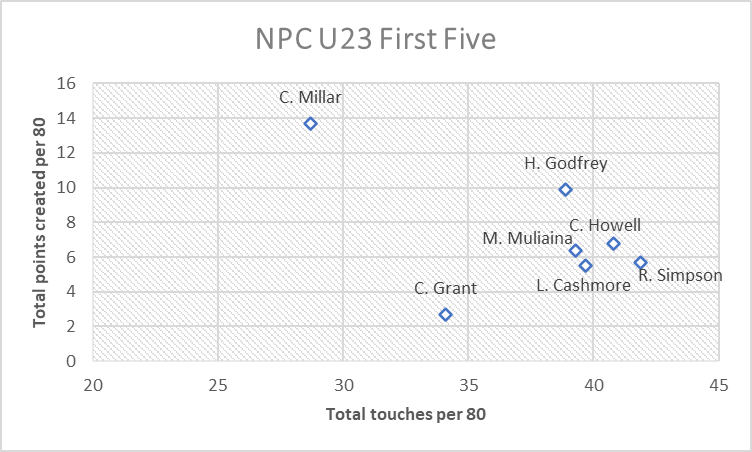
Millar found his groove in the 2025 NPC: limit your touches and rack up the points. It was a solid formula for Otago which could potentially be replicated at the Highlanders next year2028 is looking like it will be the decisive year for future NZ 10s. With Barrett, Mo’unga and potentially even McKenzie looking to depart after the 2027 Rugby World Cup, there’s an opportunity for some new blood to finally establish itself both at SRP- and at Test-level. Muliaina would do well in the meantime to build up his own portfolio as much as possible. No better place to start than the 2026 U20 World Championships in Georgia.
-
@Mauss Yep i have commented on this dilemma elsewhere. Any potential or incumbent ABs 10 needs to be playing 80 minutes at super level most of the season to get selected. With 5 teams, that means at best 5 maybe 6 potential ABs 10s. With typically 2-3 incumbents starting across the 5 teams, that gives 2 maybe 3 guys a crack each year (the lucky ones not stuck behind an AB).
Couple this up with the fact that barely any young (<25) 10s get given the keys to a super team, its a hard slog to commit to for guys coming through these age grade sides.
Of all the positions to be as a young professional rugby player in NZ, 10 would have to have the worst pathway to the next level. -
@DurryMexted said in NZ U20s 2026:
Couple this up with the fact that barely any young (<25) 10s get given the keys to a super team, its a hard slog to commit to for guys coming through these age grade sides.
Of all the positions to be as a young professional rugby player in NZ, 10 would have to have the worst pathway to the next level.Good post. We might be veering a bit off-topic here but I do think selection, and particularly long-term selection strategy, plays a big role here. A first five-eight is the kind of player you need to invest in and that means to stick with them when they’re struggling to adjust to the speed of the game. There just hasn’t been enough investment in young 10s.
Looking back, you’d say a player like Stephen Perofeta had all the tools to be an excellent 10 from a fairly young age: he’s got a good tactical brain, he’s a great runner of the ball and he has all of the ball-in-hand skills required. He was also identified as a player with great potential very early on, as he played two years of U20 rugby and started for the Blues at first five against the British and Irish Lions as a 20-year-old.
So what went wrong? Perofeta obviously has had his injury issues but I would say the lack of consistent selection at first five played a massive role as well. And here, the high performance conundrum that is the Super Rugby and NPC combination, comes to the fore again as well. From the very beginning, there was no clarity, either for Taranaki or the Blues, whether Perofeta was going to be a first five or a fullback.
For Taranaki, he started as a 15 before quickly transitioning to their preferred starting 10, only for him to switch back to fullback around 2021.
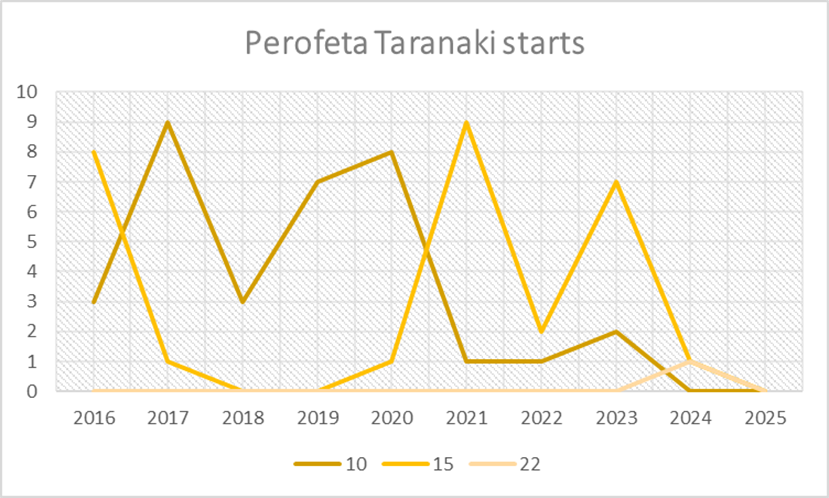
Perofeta’s starts for Taranaki: there at fullback and back againFor the Blues, Perofeta first started on the bench in the 2017 season, only for him to become the first-choice 10 for the 2018 season. His 11 starts at first five are still the most he’s had in one jersey for a Blues season, and that at 21 years of age. Afterwards, he would mostly shift between 10 and 15, the sole exception coming in the 2021 season, where he exclusively started at fullback. In 2024, he would start most of his games that season at 10, only to shift back to fullback during the playoff rounds.

Perofeta at the Blues: a 10 shifting to fullback (and back again?)Further compounding this positional vertigo is of course the fact that Perofeta would often not only shift between positions during the season but between teams as well. A good example of this is the 2020 season where Perofeta started at 10 for the Blues only to be shifted to fullback later on, with Otere Black becoming the preferred first five. But when the Whanganui playmaker would then turn up for Taranaki in the NPC, he’d play nearly exclusively at first five once again that season.
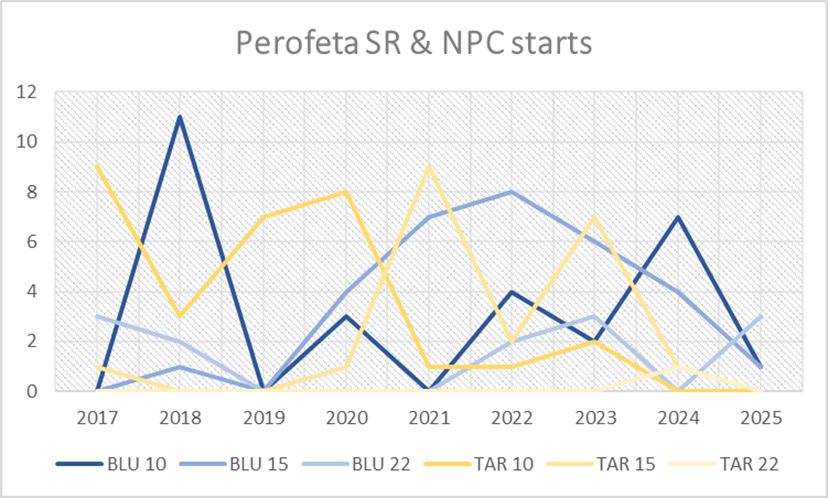
Perofeta’s combined starts for the Blues and Taranaki. I haven’t even added his AB and AB XV appearances, which would even further muddle this already chaotic chartHow would a player like Perofeta ever get comfortable in his role directing a team, if he’s constantly being shifted from one position to the other, from one team to another? Perofeta’s pathway is fine if you want to create the ultimate utility back, someone who can slot in for either playmaker role or take up a slot on the bench. But why would you want one of your most promising first five prospects to become a utility back?
That Perofeta was never destined for the AB 10-jersey becomes further clear when we compare his positional chart with that of Richie Mo’unga. Whereas Perofeta’s story (one he shares with most of his U20 first five peers) is one of constant rotation, Mo’unga’s, on the other hand, is about as straightforward as it gets. Start from the bench in the NPC, play some 10 and 15 in your first full season and then you stick to what’s working. Mo'unga, in his three Crusaders seasons leading up to his AB selection, only ever played in the 10-jersey for them.
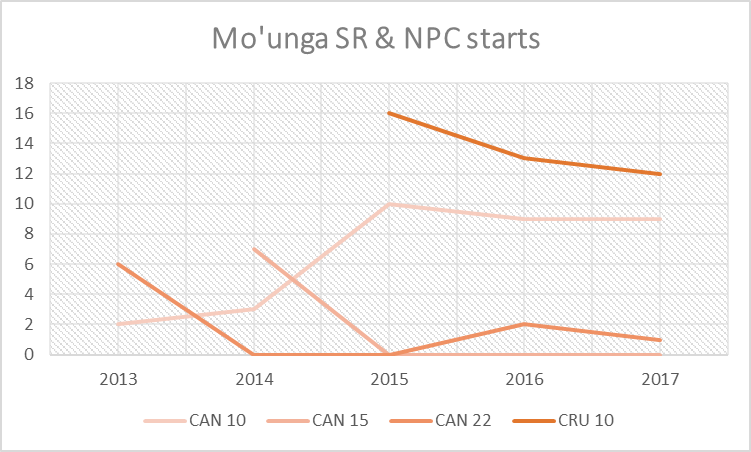
Mo’unga’s SR and NPC starts: those straight lines lead to the All BlacksI don’t think NZ Rugby has a talent-problem at first five; it has a selection-problem. When talented players like Stephen Perofeta get muddled around, you end up with a utility back, not a well-rounded first five who is ready for Test rugby.
There is an important lesson here, I think, when it comes to versatile players like Damian McKenzie and Ruben Love: while this versatility gives you early access to higher levels, in the long-term that versatility can easily turn into a poisoned chalice (I’ve no doubt that Ruben Love’s charts would look a lot more like Perofeta’s than Mo’unga’s). It is best to pick a position and to stick with it as best as possible, both at SR- and NPC-level. Otherwise, the best you can probably hope for is that AB 22-jersey, instead of the coveted number 10.
-
@Mauss Yes some clear patterns there. I think its a particular shame when a better 10 gives way to a lesser 10 just because he can also play 15.
In saying that though, I do believe that a young 10 is better off playing 15 than sitting in the stands. So limiting themselves as a specialist 10 is risking a bit of a handicap on their career opportunities, especially if they are in the development pathways of the same team as an incumbent AB 10.
I think they key to ensuring better pathways is allowing better inter-team transfers. Not sure if this looks something like limiting U23 contracts to 1 or 2 years so they can actually jump at opportunities with other super teams and have more agency over their own career? Re. Jacomb situation.
Just frustrates me how the 10 has very much been put on a pedestool the last 5 years in NZ, where a young 10 needs to do the equivalent of a Rugby PhD before hes deemed experienced enough to be given any sort of responsibility at international level.
-
@Mauss said in NZ U20s 2026:
Recently, I watched a bunch of games featuring Mika Muliaina – ranging from his First XV appearances for Southland Boys’ High to some of his recent showings for the Stags in the NPC – as I wanted to familiarize myself a bit with his game and see what kind of first five he actually is.
The thing that stood out to me was Muliaina’s patience. He doesn’t try to create a line break every time he gets the ball – an affliction young 10s can occasionally suffer from (see: Rico Simpson, young Damian McKenzie) – but is more than willing to just keep the ball moving, waiting for an opportunity to eventually present itself. And when these opportunities do present themselves, Muliaina has shown the ability to make the final pass.
https://media2.giphy.com/media/v1.Y2lkPTc5MGI3NjExcGZtNGxsMHV5d2p0bmUyNmhwaTEwZmN6bW1hMnp6MGpzbWNmOWg5aCZlcD12MV9pbnRlcm5hbF9naWZfYnlfaWQmY3Q9Zw/6TRxn3OWxuLU6MLpgp/giphy.gif
https://media1.giphy.com/media/v1.Y2lkPTc5MGI3NjExcXY3NTNienVqNm1oeHdoY25wOGJnMmthdGE0dHVrbGxnZHZseGtrZiZlcD12MV9pbnRlcm5hbF9naWZfYnlfaWQmY3Q9Zw/JpPvTQjMoKJrOUucp4/giphy.gif
Muliaina is patient for both scores, letting the forwards contract the opposition defence through multiple carries up the middle, before pulling the trigger for the easy scoreMuliaina is, in other words, a facilitator: someone who uses his vision and distribution abilities to put others into space more than looking to attack the space himself. The stats, across the different high performance-levels, further back this up.
Some of Muliaina’s per80 numbers: kicking, passing, running, defenders beaten, tackles completed, try assists and line break assists. All stats are my own, apart from those from the NPC, which I took from RugbyPassMuliaina has relatively low run numbers, especially when comparing him to some of his U23 peers like Rico Simpson (9.1 r/80), Harry Godfrey (9.3 r/80) and Lucas Cashmore (7.1 r/80). But what he perhaps lacks as a running threat, he makes up for in distribution, with high passing numbers (26.7 p/80 in the NPC) as well as solid line break assist-production (2.8 LBA/80 in the SR U20 tournament).
While Muliaina can sometimes be a tad too passive in attacking the line, he is at his best when paired with another genuine gamebreaker in the spine (Dylan Pledger for the Highlanders U20s; Jimmy Taylor for Southland Boys; Rios Tasmania for the NZ Barbarians U18s). A combination with someone like Cohen Norrie, the diminutive Auckland fullback, seems likely, with Norrie a lethal attacking threat with time and space at second receiver.
https://media3.giphy.com/media/v1.Y2lkPTc5MGI3NjExcmt6OXU4em1vOGNqNTQ0a3Rianl5dmdsaGJyZjg0dG1jd2s2ZjgwdiZlcD12MV9pbnRlcm5hbF9naWZfYnlfaWQmY3Q9Zw/VJW6CFcpKkTFYyTM6L/giphy.gif
https://media2.giphy.com/media/v1.Y2lkPTc5MGI3NjExNGk2NnhtOGpsNGNoamI3aTMzNHg4MmRnZmRyNHpkdWowdGtwaXp0ZCZlcD12MV9pbnRlcm5hbF9naWZfYnlfaWQmY3Q9Zw/QOPU7YIuonKAIHqICW/giphy.gif
Norrie is great at using his speed to isolate defenders, being able to both cut back inside and connect or burn them on the outside. He could form a potent combo with Muliaina, with the latter putting Norrie into spaceIt is when combined with this kind of X-factor that the value of a player like Muliaina truly comes to the fore, as he excels in one of the core areas of first five-play, territorial kicking.
Muliaina’s kicking outcomes across multiple games and levels (First XV, U18 rep rugby, U20 rep rugby and senior rep rugby). What distinguishes outcomes is based on territory: if the kick moves the team closer to the opposition goal line, then the outcome is a positive oneOf the 10 games, only two didn’t result in a net positive outcome: one against Australian school St. Augustine’s College at the Sanix Tournament in Japan, where SBHS decidedly overplayed ball-in-hand due to the warm conditions. And the second against Ta$man in the NPC, where Muliaina again failed to change up his game, as the Southland attack became much too lateral against a staunch Mako defence. Muliaina wasn't yet as efficient for Southland in attack as he could be, as much of the kicking was taken up by Shearer and Peni. Doing this, however, takes away one of Muliaina's main strengths.
When Muliaina does decide to go for the kick-option, more often than not good things tend to happen. While this occasionally results in a spectacular gain, like a 50/22, most of the time these kicks simply move the team into better areas.
https://media3.giphy.com/media/v1.Y2lkPTc5MGI3NjExMGZzeWNtdWhqOWpndWozcm54dXhxaWlqMjg0M296YjhkZHcxam9vbyZlcD12MV9pbnRlcm5hbF9naWZfYnlfaWQmY3Q9Zw/muKIgKb3CzaupC5d44/giphy.gif
https://media1.giphy.com/media/v1.Y2lkPTc5MGI3NjExczRrdzl2ZndydGZ3NThvbmVnYnpjMXZwZzI2MzNoYmZhbzAyb2pudyZlcD12MV9pbnRlcm5hbF9naWZfYnlfaWQmY3Q9Zw/2H1rsDvF3t1rHB3UG1/giphy.gif
Muliaina is able to kick long which, if coupled with a solid chase, can lead to substantial territory gainsThese aren’t particularly highlight-worthy pieces of play but they represent a skill which has often been undervalued by NZ 10s in recent years, which is to just kick accurately and with distance. His 56% of positive outcomes is testament to that, while his relatively low percentage of negative outcomes (16%) means that a high-volume kicking game is a real option for the NZ U20s.
Muliaina’s touch finders are another good example of this: the Southland first five is able to put his team into the opposition 22 from penalty advantage more often than not, which is massively beneficial for any attack, either to go to the maul or a lineout strike play.
https://media4.giphy.com/media/v1.Y2lkPTc5MGI3NjExZnBmb3VyMXh2OHZpeXNiOGc3N2VmZW5zdmpsYzhrN2Q4czUzaWlmOCZlcD12MV9pbnRlcm5hbF9naWZfYnlfaWQmY3Q9Zw/4Mm6WpKBT1n7fj0WnU/giphy.gif
https://media3.giphy.com/media/v1.Y2lkPTc5MGI3NjExc2IwNjBwb3J6cHhudXptdWY2bnp6MmZxZTRrcW8yMnEycndxNXJqdiZlcD12MV9pbnRlcm5hbF9naWZfYnlfaWQmY3Q9Zw/z2ChXafK1pawBNoieR/giphy.gif
https://media1.giphy.com/media/v1.Y2lkPTc5MGI3NjExZ2w0dGJ6MzRsYXhhM2ZrMmwzM2Z2MDMxZmk3d3I2cGx3eXE4djl3MSZlcD12MV9pbnRlcm5hbF9naWZfYnlfaWQmY3Q9Zw/iJMUdu47zkfeIGbXoT/giphy.gif
A good touch finder might seem innocuous enough but it often makes the difference whether the 22 entry actually delivers any pointsWith his strengths being his kicking out of hand, his patience in attack and his overall pass-selection, Muliaina has the traits of a rather classical first five-eight. He is willing to do the simplest option and do it well, rather than go for the more spectacular play. His first impulse is to not take away the space of his outsides, shifting the ball quickly to either his midfielders or his outside backs.
And while these are qualities which should translate reasonably well to higher levels – he still needs to strongly improve his defensive work and his abilities under the high ball – the question remains whether he’ll get a shot in the next few years. Because even if Muliaina performs well for the NZ U20s, that doesn’t mean he’ll quickly find his way to that other black jersey.
If we look at who actually played first five for the U20s over the past 15 years, it becomes apparent that being selected for the age grade side is anything but a guarantee for future selections to the senior side.
The list of NZ U20 10s who played the predominant role in the jersey. While no international tournament took place in 2020, Reihana was the most likely recipient of the role so I’ve included him hereWhile the first few years of U20 rugby witnessed some success stories, like Cruden, Barrett, McKenzie and Mo’unga all becoming regular ABs, the final 10 years has barely delivered anything of note.
268 minutes of Test rugby to be more precise – 264 of those belonging to Stephen Perofeta, the other 4 to Plummer – is all that is left to show for the past 10 years of NZ U20 first five development (2015-’25), with none of those minutes even coming from any meaningful time at 10. Meanwhile, 5 of those NZ U20 first fives are now playing overseas (Black, Falcon, Plummer, Burke and Morgan), with one (Burke, SCO) having already played for another country while 2 others might soon come into consideration (Black, Falcon, JP).
Those that remained in New Zealand – Perofeta, Reihana, Cashmore, Kemara and Simpson – have struggled in their own way, with very few opportunities available to them. Perofeta has mainly featured at fullback for the Blues, while it took an injury crisis at the Crusaders for Reihana to finally get an extended shot at pivot at Super Rugby-level. Someone like Cashmore has even struggled to string together Super Rugby contracts, despite leading an NZ U20 attack which averaged 58 points per game at the 2022 Oceania U20 Championship. Who knows when Rico Simpson will get his shot, with both Beauden Barrett and Perofeta still ahead of him at the Blues.
Muliaina will face a similar battle at the Highlanders, with Josh Jacomb arriving in 2027 and a rejuvenated Cam Millar looking to establish himself at Super Rugby-level in 2026 after finding his style of play at first five alongside Dylan Pledger at halfback in the NPC.
Millar found his groove in the 2025 NPC: limit your touches and rack up the points. It was a solid formula for Otago which could potentially be replicated at the Highlanders next year2028 is looking like it will be the decisive year for future NZ 10s. With Barrett, Mo’unga and potentially even McKenzie looking to depart after the 2027 Rugby World Cup, there’s an opportunity for some new blood to finally establish itself both at SRP- and at Test-level. Muliaina would do well in the meantime to build up his own portfolio as much as possible. No better place to start than the 2026 U20 World Championships in Georgia.
Really enjoyed this analysis @Mauss .
What I like about him is that he doesn't overplay any one particular hand. Ehich indicates he is a strong decision maker. He has a nice skip out pass, can make a break ehen running from first receiver, has a good kick pass and as you mention his long kicking is first rate.
Biggest weaknessss at the moment seem to be unfer the highball and on defence. Which, if they could be fixed by 20 or 21 he will be well ahead of the game.
As you mentioned, very few U20s 10s have come through. I did a countback a while ago where I tried to work out who has played a lot of test rugby at 10 since Andrew Mehrtens. It wss very few guys over three decades.
From the comments of Jamie Joseph over the last year and a bit. It seems like he is a big fan. Im a recent Highlanders video, he singled him out (alongside Solomon and Pledger) as two who have impressed during pre-season. Highly likely he is a fully contracted player in 2027. When he will still be eligible for the U20s.
Some are saying Jacomb may be standing in his way. I don't see it like that. At the end of Jacomb's intial contract period Muliaina will only be 21. If Jacomb does another two years. He will still only be turning 24 when he potentially leaves. At that point he will be coming into the peak of his powers.
I think the kid has a lot of potential. We just need to be patient with him. Just because he made his provincial debut at 18, doesn't mean he needs to become a rockstar overnight.
-
@SouthernMann said in NZ U20s 2026:
Biggest weaknessss at the moment seem to be unfer the highball
He aint alone!