Law trials and changes
-
Developed to make the breakdown safer, fairer and simpler to understand, the new guideline debuted during Super Rugby Aotearoa and Super Rugby AU. Here’s how it has impacted the game so far.
Implemented in March 2020, the new breakdown law application guideline recently made its world debut in Super Rugby Aotearoa, closely followed by its Australian introduction in Super Rugby AU.
Developed by a specialist breakdown working group consisting of the global game’s leading players, coaches and referees, including Joe Schmidt, Richie Gray, Ian Foster, Victor Vito and Wayne Barnes, Jaco Peyper and Dr Eanna Flavey the guideline is a strict reinforcement of existing law designed to promote a safer, fairer contest at the breakdown that is easier to referee and enables faster, attacking rugby.
With Super Rugby Aotearoa wrapped up and rugby’s restart in neighbouring Australia now well underway, World Rugby has analysed the matches played so far across both competitions to find out if the new guideline has delivered on its goals.
SUPER RUGBY AOTEAROA ENJOYS FASTER BALL
In New Zealand, teams and spectators enjoyed an increase in ruck speed, with average quick ball in the opposition half reducing to 2.76 seconds from 3.1 seconds in the previous season. This is significant because the evidence indicates that shorter breakdowns lead to fewer injuries.
The competition's combined penalty kick and free kick count dropped by nine – from 31 to 22 – across nine rounds of Super Rugby Aotearoa. Consistent with the data from Australia, penalties at the breakdown also reduced from rounds one to nine of the tournament, from 20 to 13.
The drop in penalty count over time across both competitions shows a clear change in behaviour and an acceptance and understanding of the new breakdown law application guideline from players, coaches and referees.
The new guideline has also had a clear impact on the split of ruck penalties between attack and defence in New Zealand. The past average shows that attacking teams are penalised less at the breakdown, claiming 44 per cent of the total. Yet, across nine rounds of Super Rugby Aotearoa this figure has risen to 51 per cent – evidence of a more equal competition at the breakdown.
BALL IN PLAY FOR LONGER IN SUPER RUGBY AU
In the opening six rounds of Super Rugby AU, the ball was in play for an average of 36 minutes 15 seconds – three minutes 42 seconds longer than the average time clocked by Australian Super Rugby teams in the previous season.
This increase in ball in play enabled an average of 40 more passes per game than previously recorded, showing an increase in free-flowing, attacking rugby.
Super Rugby AU has also recorded a clear change in how the game is being played at the breakdown. From rounds one to six, the number of penalties blown at the breakdown decreased from 13 to nine, with fewer penalties called for holding on than recorded in the previous season.
‘FANTASTIC FOR THE GAME’
After its restart on 15 August, England’s Premiership Rugby is also now applying the new breakdown law application guideline. English referee and member of the specialist breakdown working group, Wayne Barnes, spoke on BT Sport to give his reaction to the introduction of the guideline and to share some insights from its development:
“This is the top coaches, the top players in the world saying, as part of a working group, this is how we can make the game safer, this is how we can make the game fairer, and this is how we can make it more understandable.
“This (the new guideline) was all about improving player safety. Players were bent over and their necks were exposed and they were just bracing until players arrived to clear them out. What we’re saying is we want them lifted, we want them higher, and we want players who arrive cleaning them out safely, driving them backwards. We want that ball in play. We want to encourage continuity.
“We’re seeing the players adapting, we’re seeing coaches adapting. They’re buying into what we’ve been asked to do. That’s fantastic for the game.”
In the time since the new guideline was announced, World Rugby has been working with referees, teams and unions to ensure full alignment and understanding of it.
World Rugby has also published comprehensive step-by-step guidance on the application of the new guideline, featuring detailed explanations and video examples.
Rugby World Cup 2011 final referee, Craig Joubert, has been educating emerging nations’ high performance staff and union referee managers and referees on the breakdown law application guideline via the newly-launched World Rugby Virtual High Performance Academy.
Read more: World Rugby issues breakdown law application guideline >>
@Stargazer Any mention on the timing involved in the seemingly endless resetting of scrums?
-
-
@booboo I don't like it. Not sure it adds much to the game - and will completely change the risk/reward of grubbers into the in goal.
I hate the captain's review. Refs are refs, they are gods walking amongst the players, and TMO can't even figure out forward passes
-
@KiwiMurph far out, how many gimmicks do you need?
Not delighted the comps are differnet, given we're going to a crossover later in the year. Reminds me of 2009 France in Dunedin where we had played with the shocking ELV all year, and went back to 'normal' rugby for the tests. No surprise, we weren't that good at it (and a great win by the Frogs)
-
@KiwiMurph far out, how many gimmicks do you need?
Not delighted the comps are differnet, given we're going to a crossover later in the year. Reminds me of 2009 France in Dunedin where we had played with the shocking ELV all year, and went back to 'normal' rugby for the tests. No surprise, we weren't that good at it (and a great win by the Frogs)
@nzzp said in Law trials and changes:
@KiwiMurph far out, how many gimmicks do you need?
There are about 140 of them called "Laws"

Not delighted the comps are differnet, given we're going to a crossover later in the year.
Perhaps

-
@booboo I don't like it. Not sure it adds much to the game - and will completely change the risk/reward of grubbers into the in goal.
I hate the captain's review. Refs are refs, they are gods walking amongst the players, and TMO can't even figure out forward passes
@nzzp said in Law trials and changes:
I hate the captain's review. Refs are refs, they are gods walking amongst the players, and TMO can't even figure out forward passes
If fans didn't whinge about officiating every few minutes we wouldn't be getting captain reviews. We get what we deserve.
-
I am not sure I like the goal line drop kick from an attacking kick that is grounded by the defending team. We risk ending up with a league style of a few 'hit ups' then a kick. I wonder if the same rule applies if a kick to the in goal is taken on the full?
On the flip side, it may help combat the rush defence.
-
I am not sure I like the goal line drop kick from an attacking kick that is grounded by the defending team. We risk ending up with a league style of a few 'hit ups' then a kick. I wonder if the same rule applies if a kick to the in goal is taken on the full?
On the flip side, it may help combat the rush defence.
@Crazy-Horse said in Law trials and changes:
I am not sure I like the goal line drop kick from an attacking kick that is grounded by the defending team. We risk ending up with a league style of a few 'hit ups' then a kick. I wonder if the same rule applies if a kick to the in goal is taken on the full?
On the flip side, it may help combat the rush defence.
I think I saw in the Ferald - if a kick is taken on the full - they can claim a mark, and the kick is from 5m line?
I notice a 'law variation' in that graphic which I'd have thought most widely reported/publicised, but wasn't even mentioned in Ferald, and other headlines I've seen - a red-carded player can be replaced after 20 minutes?
-
@Crazy-Horse said in Law trials and changes:
I am not sure I like the goal line drop kick from an attacking kick that is grounded by the defending team. We risk ending up with a league style of a few 'hit ups' then a kick. I wonder if the same rule applies if a kick to the in goal is taken on the full?
On the flip side, it may help combat the rush defence.
I think I saw in the Ferald - if a kick is taken on the full - they can claim a mark, and the kick is from 5m line?
I notice a 'law variation' in that graphic which I'd have thought most widely reported/publicised, but wasn't even mentioned in Ferald, and other headlines I've seen - a red-carded player can be replaced after 20 minutes?
@Kruse said in Law trials and changes:
I notice a 'law variation' in that graphic which I'd have thought most widely reported/publicised, but wasn't even mentioned in Ferald, and other headlines I've seen - a red-carded player can be replaced after 20 minutes?
For some reason I read that as red-headed
 ... but I think it can work.
 -
@Crazy-Horse said in Law trials and changes:
I am not sure I like the goal line drop kick from an attacking kick that is grounded by the defending team. We risk ending up with a league style of a few 'hit ups' then a kick. I wonder if the same rule applies if a kick to the in goal is taken on the full?
On the flip side, it may help combat the rush defence.
I think I saw in the Ferald - if a kick is taken on the full - they can claim a mark, and the kick is from 5m line?
I notice a 'law variation' in that graphic which I'd have thought most widely reported/publicised, but wasn't even mentioned in Ferald, and other headlines I've seen - a red-carded player can be replaced after 20 minutes?
@Kruse said in Law trials and changes:
I notice a 'law variation' in that graphic which I'd have thought most widely reported/publicised, but wasn't even mentioned in Ferald, and other headlines I've seen - a red-carded player can be replaced after 20 minutes?
that's old news - was in play last year as well I believe, so not 'new'. In modern media, that's ancient talk ... apprently not interesting or relevant
-
We already had the red card variation and golden point in NZ, last year. So only two changes in SR Aotearoa.
I agree it will be confusing for SR TT later in the season that the variations aren't the same for both competitions.
I prefer this picture from the SANZAAR media release:

You can find all the media releases here:
Super Rugby Aotearoa (NZ website): https://www.superrugby.co.nz/news/goal-line-drop-out-captains-referral-to-feature-in-sky-super-rugby-aotearoa/
Super Rugby AU (Aussie website): https://www.rugby.com.au/news/2021/02/09/super-rugby-au-2021-law-variation
Both (SANZAAR website): https://super.rugby/superrugby/news/super-rugby-innovative-law-variations-to-continue/
-
@Kruse said in Law trials and changes:
I notice a 'law variation' in that graphic which I'd have thought most widely reported/publicised, but wasn't even mentioned in Ferald, and other headlines I've seen - a red-carded player can be replaced after 20 minutes?
that's old news - was in play last year as well I believe, so not 'new'. In modern media, that's ancient talk ... apprently not interesting or relevant
@nzzp said in Law trials and changes:
@Kruse said in Law trials and changes:
I notice a 'law variation' in that graphic which I'd have thought most widely reported/publicised, but wasn't even mentioned in Ferald, and other headlines I've seen - a red-carded player can be replaced after 20 minutes?
that's old news - was in play last year as well I believe, so not 'new'. In modern media, that's ancient talk ... apprently not interesting or relevant
I did wonder if that was the case, but couldn't remember it... but instead, had memories of people on here suggesting it on average once a day, always as if it was a radical new idea - as recently as... well, last week.
-
@Kiap I'm sure there were no red cards in Super Rugby Aotearoa; and I don't think there were in Super AU either. I can only find one citing and suspension from the post-covid competitions and Kobus van Wyk wasn't red carded in the game he made his illegal tip tackle.
-
@nzzp said in Law trials and changes:
@Kruse said in Law trials and changes:
I notice a 'law variation' in that graphic which I'd have thought most widely reported/publicised, but wasn't even mentioned in Ferald, and other headlines I've seen - a red-carded player can be replaced after 20 minutes?
that's old news - was in play last year as well I believe, so not 'new'. In modern media, that's ancient talk ... apprently not interesting or relevant
I did wonder if that was the case, but couldn't remember it... but instead, had memories of people on here suggesting it on average once a day, always as if it was a radical new idea - as recently as... well, last week.
@Kruse said in Law trials and changes:
@nzzp said in Law trials and changes:
@Kruse said in Law trials and changes:
I notice a 'law variation' in that graphic which I'd have thought most widely reported/publicised, but wasn't even mentioned in Ferald, and other headlines I've seen - a red-carded player can be replaced after 20 minutes?
that's old news - was in play last year as well I believe, so not 'new'. In modern media, that's ancient talk ... apprently not interesting or relevant
I did wonder if that was the case, but couldn't remember it... but instead, had memories of people on here suggesting it on average once a day, always as if it was a radical new idea - as recently as... well, last week.
yeah, media covered it, but it only affects the occasional game, so doesn't get much attention.
-
Not a law trial or new law variation. This is more about the application of the existing law.
World Rugby furthers head injury prevention commitment with expanded Head Contact Process
World Rugby has publicly launched the Head Contact Process (HCP) to assist the sanctioning process for contact with the head and neck, underscoring the sport’s commitment to head injury prevention. This process has been developed through extensive collaboration and consultation with current and former players, coaches, referees and medical experts.
The HCP is an evolution of the High Tackle Sanction Framework, which supported rugby’s ambition of reducing the risk of head injury through stronger and more consistent on and off field sanctioning of high-risk tackle actions, in turn encouraging a positive change in player behaviour.
Within the evolved HCP, the scope for sanction consideration has been broadened to include all illegal head and neck contact, including dangerous clean-outs, head-on-head collisions and head contact which arises from ball carriers leading with an elbow or forearm, in addition to high tackles and shoulder charges.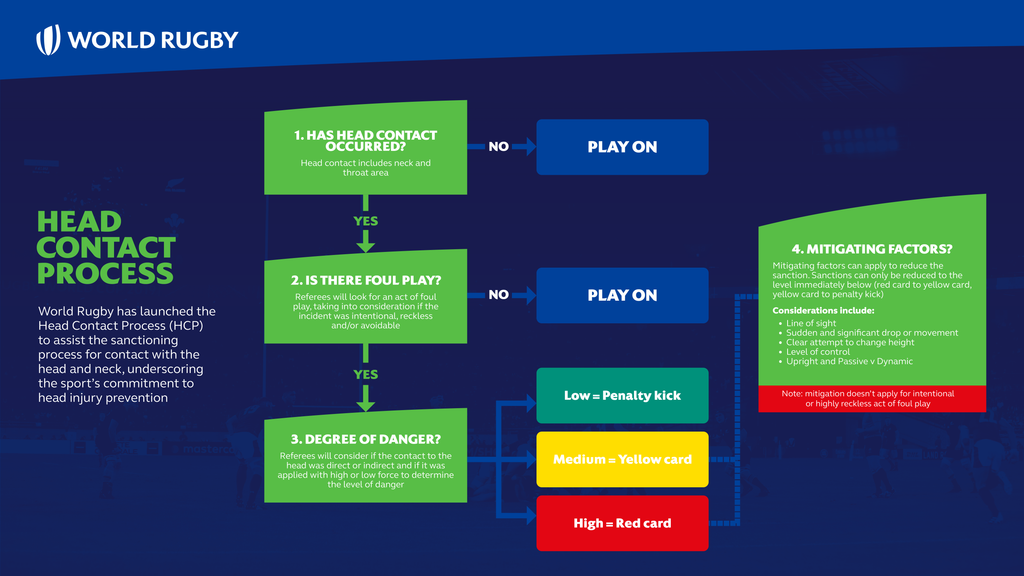
While already in operation in the Guinness Six Nations and across elite competitions around the world, the HCP will now come into effect immediately at all levels of the game in the form of a Law Application Guideline. It will be supported by a sport-wide education process for players, coaches and match officials, also furthering concussion awareness.
With the game united in its commitment to protecting players, the HCP is the result of a comprehensive, collaborative and scheduled review of the High Tackle Sanction Framework actioned at the Player Welfare Symposium in Paris in March 2020. It was undertaken by a multi-disciplinary review group featuring players, coaches, referees, medics and disciplinary representatives*.*The High Tackle Sanction Framework Review Group: Bernard Laporte (Chair), Conrad Smith and David Quinlan (IRP), Richie Gray, Dave Rennie and Gregor Townsend (coaches), Wayne Barnes and Jaco Peyper (referees), Christopher Quinlan QC and David Barnes (judicial and citing), Dr Martin Raftery and Professor Ross Tucker (medical and research), Alan Gilpin, Joe Schmidt, Mark Harrington, Dr Éanna Falvey, Joël Jutge, Paddy O’Brien, Yvonne Nolan, Steve Hinds, Rhys Jones and Dominic Rumbles (World Rugby).
You can find the new Law Application Guideline here: https://www.world.rugby/the-game/laws/guidelines/17 (includes videos)